

Motorcycle tire pressure is a crucial topic that should never be underestimated. Yet many riders act carelessly when it comes to this issue. Sometimes it’s due to lack of knowledge, other times it’s simply convenience mixed with complacency. In this comprehensive guide, we’ll explain the effects – both positive and negative – of tire pressure on motorcycles, and share the recommended values and best practices.
Table of Contents
Why is motorcycle tire pressure so important?
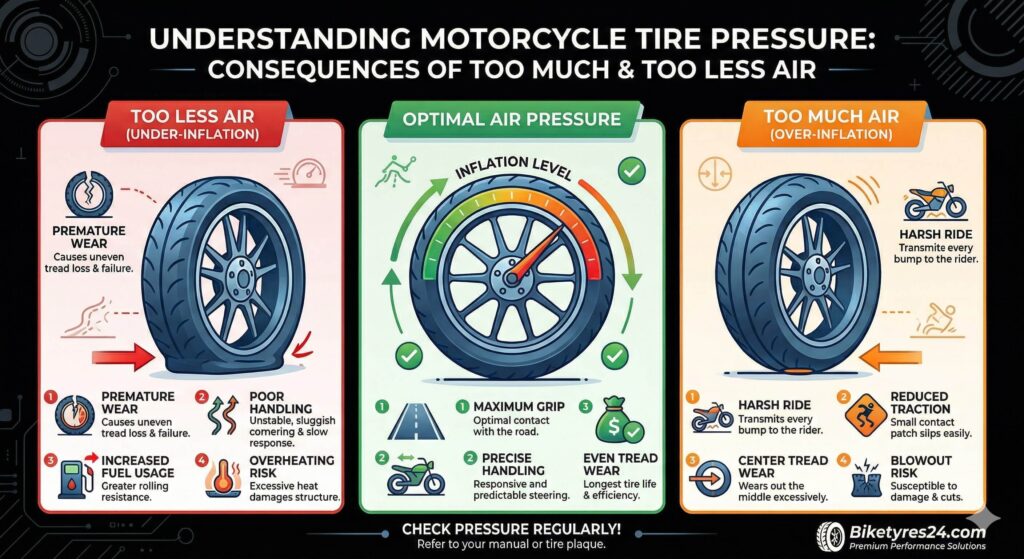
The air inside your tires carries the load of the motorcycle, including the weight of the rider, passenger, and any luggage. If the tire pressure isn’t correct, you’ll feel it while riding. Incorrect pressure affects handling, wear, and overall safety. Here’s how overinflation and underinflation impact your ride:
Effects of too much tire pressure:
- Increased wear on the center tread
- Lower fuel consumption
- Tires struggle to reach optimal temperature
- Reduced comfort
- Less stability
- Sharper handling
- Potential damage to suspension
- Risk of tire blowout
- Poor tire feedback
Effects of too little tire pressure:
- Increased wear on the tire shoulders
- Higher fuel consumption
- Excessive heat buildup
- More comfort
- Greater stability
- Sluggish handling
- Potential tire damage
- Longer braking distance
- Poor wet grip
How often should you check motorcycle tire pressure?
There’s no universal rule for how often to check tire pressure. Factors like temperature and road conditions play a role. In hot or tropical climates with high humidity, you should check tire pressure more frequently than in places like Europe or Northern Americas, where summer temperatures are relatively stable.
As a general recommendation, check your motorcycle’s tire pressure every two weeks. Visually inspect the tires for damage or air loss before every ride. To get an accurate reading, measure the pressure when the tire is cold (below 30°C). If you’re planning a longer trip, check the pressure before and during your journey at regular intervals. At the start of the riding season, after a long break, it’s especially important to check and adjust tire pressure before hitting the road.
If your tire pressure is too low, you’ll usually notice a change in handling. Stop the bike immediately and check the pressure to avoid accidents.
If you want real-time alerts instead of manual checks, consider installing a tire pressure monitoring system (TPMS).
Recommended motorcycle tire pressure values
Whether you ride a 1000cc superbike, a 600cc sportbike, or a naked bike – the standard tire pressure is now fairly consistent across the board. The pressure recommended by the bike or tire manufacturer varies by model, but for street motorcycles, it typically ranges from 2.25 to 2.5 bar in the front and 2.5 to 2.9 bar in the rear. However, the ideal pressure can differ depending on the tire and motorcycle.
In recent years, a standard pressure has become common: 2.5 bar front and 2.9 bar rear. This value is agreed upon by tire suppliers and manufacturers to ensure safe operation under all road conditions. It guarantees the maximum load capacity and top speed, and legally protects the manufacturer.
Still, the standard pressure isn’t always the best for performance. This is especially true for hypersport tires designed for track use. Manufacturers often publish pressure charts with ideal values for sporty riding.
Lowering or raising motorcycle tire pressure – does it make sense?
Depending on how you ride, adjusting the standard pressure can be beneficial. Here’s what to consider:
Lowering tire pressure: Sporty riders may improve handling or grip by slightly lowering tire pressure. But be careful – track pressures (often 1.2–1.6 bar) are not suitable for street tires. Track tires have stiffer carcasses and are designed to operate at those pressures once they reach operating temperature (80°C or more).
For spirited riding on twisty roads with street or hypersport tires, you can safely experiment with slightly lower pressures. For example, reducing front pressure to around 2.2 bar and rear to 2.3 bar can improve grip and handling. The tire heats up faster, maintains temperature more easily, and performs better overall. During sporty riding, tire pressure typically increases by 0.3 to 0.4 bar, reaching the ideal warm pressure.
Recommended settings for solo sport riding on twisty roads:
- Front: 2.3 bar cold (target 2.6 bar warm)
- Rear: 2.4 bar cold (target 2.8 bar warm)
Possible Advantages of Lower Tire Pressure
- Tires reach operating temperature more quickly
- Tires maintain temperature more effectively
- Potentially increased contact patch, which can improve grip
- Improved ride comfort and damping
Possible Disadvantages of Lower Tire Pressure
- Increased wear
- Risk of tire damage due to underinflation
- Potential increase in upright steering force
- Possibly more steering effort required
- Reduced agility
Increasing Motorcycle Tire Pressure: Raising tire pressure makes little sense on modern motorcycles and tire models. As mentioned earlier, the recommended values are already the maximum limits that ensure safe high-speed riding under full load.
Remember:
- Do not exceed the manufacturer’s standard pressure values—they already represent the upper limits.
- For road tuning, you can experiment with slightly lower pressures.
- Do not deviate more than 0.4–0.6 bar downward / minimum 2.2 bar front, 2.3 bar rear.
- Never use track-level pressures on street tires!
Tire Pressure for Winter Storage
If you’re storing your motorcycle for the winter and not using paddock stands, you should increase the tire pressure. This helps prevent flat spots. Motorcycle tires are especially prone to flat-spotting, and affected tires often need to be replaced. We recommend increasing tire pressure by 0.5–1.0 bar during winter storage. Even better: use paddock stands so the tires don’t touch the ground at all.
Motorway Tire Pressure
On the motorway, always follow the manufacturer’s recommendations. Modern motorcycles and tire models use standardized pressure values that ensure safe operation at top speeds. Increasing tire pressure for long motorway rides is generally not advisable.
Passenger Load Tire Pressure
Until a few years ago, most motorcycles, especially touring models, had two pressure values listed: one for solo riding and one for riding with a passenger or luggage. Today, most manuals only list the higher value, which can still be adjusted individually. If you often ride solo on twisty roads, you can lower the pressure slightly. As a rule of thumb: for heavy loads and high-speed travel, always use the maximum value specified for your bike.
Track Tire Pressure
Track tire pressures differ significantly from those used on the road. On the racetrack, tires reach much higher temperatures, which allows for much lower pressures. Keep in mind that track tires often have special carcasses designed to handle these low pressures. Using track pressures on street tires makes no sense – the carcass simply isn’t strong enough, and the result is unsafe handling. Always follow the manufacturer’s recommended values for track tires. You’ll find a table with ideal track pressures here…
Supermoto Tire Pressure
Supermotos are extremely lightweight motorcycles and therefore require lower tire pressures. For example, models like the KTM 690 SMC R, GasGas 700 SM, or Husqvarna 701 are recommended to run significantly lower pressures than larger bikes. These recommendations also apply to lightweight Supermoto conversions.
Depending on the tire and bike model, pressure recommendations vary slightly. The lowest value we found in our research was 2.0 bar front and rear for the 690-class Supermoto models from all three manufacturers. Depending on the tire brand and model, pressures range up to 2.3 bar front and 2.5 bar rear.
In general, we recommend 2.0 bar front and 2.0–2.2 bar rear for Supermotos. Do not go significantly lower, as this can damage the carcass or tread.
Smaller Supermotos in the 50cc and 125cc class may be safely run at 1.8–2.0 bar.
Tip: The specialized Supermoto tire ContiAttack SM is approved with pressures of 2.0–2.3 bar front and 2.0–2.5 bar rear for street-legal Supermotos from KTM, Husqvarna, and GasGas. Despite the bikes being nearly identical, Husqvarna recommends 2.0 bar all around, GasGas 2.2 bar all around, and KTM 690 SMC-R even 2.3 to 2.5 bar as the ideal range.
Custom Motorcycle Tire Pressure
Custom bikes with extremely wide rear tires may require special pressure settings. When in doubt, always follow the tire manufacturer’s recommendations.
Motorcycle Tire Pressure Table
Here’s our motorcycle tire pressure table with general reference values and recommendations by vehicle category.
| Bike Type | Front Pressure (psi) | Rear Pressure (psi) | Best For… |
| Sportbikes / Superbikes | 32 – 36 | 36 – 42 | High-speed stability and cornering. |
| Cruisers / Heavy Touring | 36 – 40 | 40 – 42 | Supporting heavy weight and passengers. |
| Adventure (ADV) – On-Road | 32 – 35 | 36 – 40 | Balanced handling and fuel economy. |
| Adventure (ADV) – Off-Road | 18 – 25 | 20 – 28 | Increased footprint and traction on dirt. |
| Dual Sport / Dirt Bikes | 12 – 18 | 12 – 15 | Maximum grip on loose surfaces. |
| Standard / Naked Bikes | 30 – 34 | 34 – 38 | Daily commuting and general versatility. |
Approximate values only—please refer to your owner’s manual or tire approval documentation for exact specifications.
Convert bar to PSI and vice versa
Pressure conversion is one of those things that seems tricky until you see the math behind it. Whether you’re at a gas station with a metric pump or checking your bike’s manual, knowing how to jump between bar (metric) and PSI (Pounds per Square Inch) is a vital skill for any rider.
The Magic Numbers
To convert between the two, you just need one constant: 14.5038. Most people round this to 14.5 for quick “parking lot math.”
- Bar to PSI: Multiply by 14.5038
- Formula: Ppsi=Pbar×14.5038
- PSI to Bar: Divide by 14.5038
- Formula: Pbar=14.5038Ppsi
Here is a handy table showing typical ranges you’ll see for street bikes and dirt bikes
| Motorcycle Type | Pressure in PSI | Pressure in Bar | Use Case |
| Street (Front) | 32 PSI | 2.21 bar | Standard commuting |
| Street (Rear) | 36 PSI | 2.48 bar | Standard commuting |
| Street (Rear – Loaded) | 42 PSI | 2.90 bar | With passenger/luggage |
| Sportbike (Track) | 30 PSI | 2.07 bar | Warm tires, high grip |
| Dual Sport/Dirt | 22 PSI | 1.52 bar | Mixed trail riding |
| Off-Road (Enduro) | 12 PSI | 0.83 bar | Maximum traction (soft dirt) |
Do you have comments or questions about motorcycle tire pressure? Leave us a message—we’d love to hear from you!
