Close Menu
    What's Hot

    Why racing tyres are so expensive: material costs, manufacturing, and testing effort

    04.10.2026

    How to Properly Warm Up Your Tires on Track Without Warmers

    13.09.2026
    6.2

    Apollo Tramplr XR Review & Rider Experiences

    03.09.2026
    TikTok Instagram Facebook WhatsApp
    • Avon
    • Bridgestone
    • Continental
    • CST
    • Dunlop
    • Heidenau
    • Maxxis
    • Metzeler
    • Michelin
    • Mitas
    • Pirelli
    Biketyres24 Blog
    Instagram TikTok Facebook WhatsApp
    • Blog
    • Featured

      Pirelli Slicks Rim Compatibility Guide

      02.08.2026

      CFMoto 675 Tyre Recommendations: The Best Tyres for 675 NK & 675 SR‑R

      05.06.2026

      How to Break In New Motorcycle Tires: Tips, Duration & Common Myths

      24.03.2026

      Motorcycle Tire Warmers Guide: A Must-Have for Track Performance

      24.03.2026

      Handling Slick Tires: Tips for Storage & Mounting

      24.03.2026
    • Reviews
      6.2

      Apollo Tramplr XR Review & Rider Experiences

      03.09.2026
      7.2

      Maxxis Supermaxx HS Review & Rider Experiences

      20.08.2026
      9.0

      Bridgestone Battlax RS12 Trackday Review

      29.07.2026
      8.0

      Metzeler Sportec 01 Review & Rider Experiences

      19.07.2026
      7.3

      Bridgestone Battlax RS12 Review & Rider Experiences

      31.05.2026
    • Guides

      Why racing tyres are so expensive: material costs, manufacturing, and testing effort

      04.10.2026

      How to Properly Warm Up Your Tires on Track Without Warmers

      13.09.2026

      Pirelli Slicks Rim Compatibility Guide

      02.08.2026

      CFMoto 675 Tyre Recommendations: The Best Tyres for 675 NK & 675 SR‑R

      05.06.2026

      Motorcycle Tire Recommendations for BMW GS Models

      10.05.2026
    • Racetrack

      Why racing tyres are so expensive: material costs, manufacturing, and testing effort

      04.10.2026

      How to Properly Warm Up Your Tires on Track Without Warmers

      13.09.2026

      Pirelli Slicks Rim Compatibility Guide

      02.08.2026
      9.0

      Bridgestone Battlax RS12 Trackday Review

      29.07.2026
      9.0

      Metzeler Racetec TD Slick Review & Rider Experiences

      29.03.2026
    • Accessories

      Motorcycle Tire Repair Spray Recommendations

      24.03.2026

      Motorcycle Tire Warmers Guide: A Must-Have for Track Performance

      24.03.2026

      Motorcycle Tire Changing & Balancing – Tools

      24.03.2026

      Motorcycle Tire Warmers – Guide, Models, Test

      06.03.2026

      Motorcycle Stand Recommendations & Guide

      28.02.2026
    • Bike Care

      Motorcycle Tire Shine Spray – Application & Recommendations

      20.02.2026

      Motorcycle Wheel Cleaner Guide: Top Products & Tips

      20.02.2026

      The Ultimate Motorcycle Care Product Guide

      17.02.2026

      Motorcycle Chain Maintenance Guide

      17.02.2026

      Motorcycle Brake Caliper Maintenance Tips

      17.02.2026
    • News

      From Circuit to Street: The New Bridgestone Battlax Racing Street RS12 Arrives for 2026

      28.03.2026

      New Motorcycle Tires 2026: Innovations for the Upcoming Season

      28.03.2026
    • Shop
    Shop
    Biketyres24 Blog
    Blog » Guides » How to Break In New Motorcycle Tires: Tips, Duration & Common Myths
    Guides

    How to Break In New Motorcycle Tires: Tips, Duration & Common Myths

    Biketyres24-TeamBy Biketyres24-Team24.03.2026No Comments7 Mins Read27 Views
    Share WhatsApp Email Copy Link
    How to Break In New Motorcycle Tires - Tips, Duration & Common Myths
    Share
    Facebook Twitter WhatsApp Telegram Email Copy Link

    In this guide, we’re diving into the topic of breaking in motorcycle tires. The first few kilometers on new tires require extra caution – there are countless horror stories of riders who crashed brand-new bikes or went down immediately after a tire change. Why it’s important to break in new motorcycle tires and how to do it properly is exactly what we’ll explain in this article.

    Table of Contents

    • Why break in new motorcycle tires?
    • And what about that old release agent myth?
    • New tire model, new riding feel
    • How long does it take to break in motorcycle tires?
    • How to break in new motorcycle tires
    • What about using sandpaper to break in tires?

    Why break in new motorcycle tires?

    Every tire needs to be “broken in” through riding. When you mount a brand-new tire, its surface is still sealed and smooth. In simple terms, that means the tire is still a bit slippery. If you push a new tire to its limits right away, it won’t be able to generate mechanical grip and won’t “mesh” properly with the asphalt. That’s why it’s crucial to break in the tire and roughen up the smooth surface.

    This process makes the rubber more porous and grippy on a microscopic level. It increases the contact area at the micro level, allowing the tire to interlock with the road surface.

    You’ll know the tire is broken in when its surface becomes rough – this is called the conditioning effect. It’s caused by contact with the asphalt and the heat generated during riding. That rough surface is exactly what you want, because it delivers the grip and performance the tire was designed for.

    So ultimately, breaking in motorcycle tires is all about creating mechanical grip, which only develops once the rubber becomes porous.
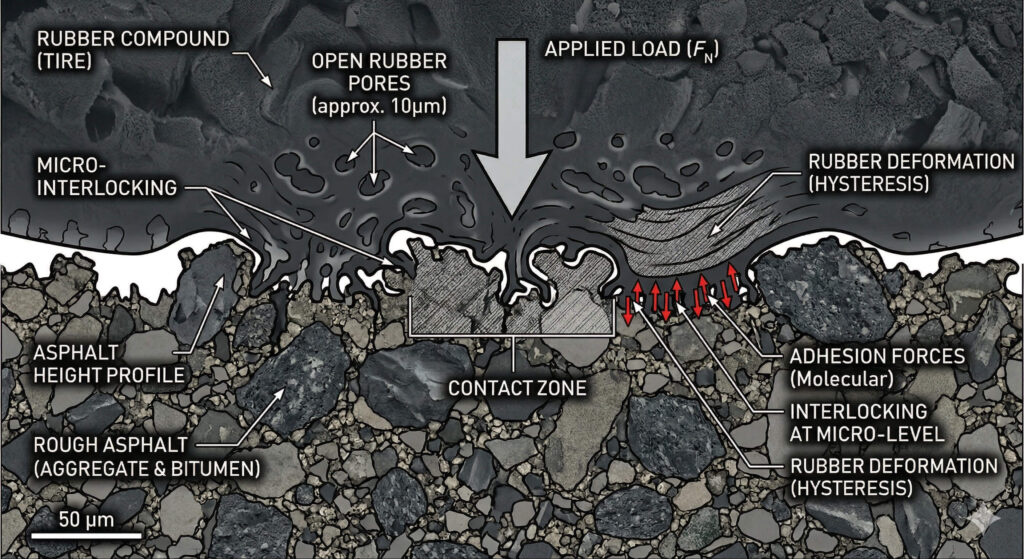
    Detailed Technical Illustration Motorcycle Tire Break In Period

    And what about that old release agent myth?

    It’s true that in the past, slippery release agents caused plenty of crashes with new tires. Thankfully, those days are long gone. With advances in tire manufacturing, modern release methods have taken over. Today, nearly all manufacturers release tires from molds without using greasy release agents. Instead, high-tech Teflon coatings are used in the molds, allowing tires to be removed cleanly without leaving any residue on the rubber.

    We’ve confirmed with several major tire manufacturers that at least for sporty street tires, no slippery release agents are used anymore. Continental even promotes its Traction Skin technology, which enables extremely short break-in times. This is achieved by eliminating release agents and pre-roughening the tire surface to create a conditioning effect. This pre-conditioning is especially common in sport models from the ContiAttack series – one of the most popular being the ContiAttack SM Evo.

    Here’s an excerpt from Continental’s product description:

    “TractionSkin ensures an extremely safe and short break-in period. This is made possible by the revolutionary roughened tire surface and the elimination of release agents through specially coated molds.”

    Key facts about release agents on motorcycle tires:

    • Slippery release agents are no longer used by reputable manufacturers or on high-quality tires.
    • Some manufacturers promise shorter break-in times thanks to additional surface treatments that create a porous rubber structure, allowing the tire to mesh with the asphalt more quickly.

    New tire model, new riding feel

    It’s not just the tire surface that affects break-in time, every tire model is different and may surprise you with a completely new riding feel. Maybe your old tire resisted turning in, while the new one dives into corners effortlessly. Or maybe your old hypersport tire had tons of grip at every lean angle, while your new touring tire offers less grip and tends to slide more.

    Wet-weather performance also varies greatly between models and manufacturers, and it takes time for the rider to adjust. Breaking in a new motorcycle tire also means getting used to its handling characteristics before gradually pushing its limits.

    How long does it take to break in motorcycle tires?

    There’s no fixed rule—it depends on the tire model and your riding style. Soft sport tires are usually broken in within a few kilometers (e.g. Michelin Power 6 or ContiAttack SM Evo), racetrack slicks and treaded race tires may be ready after just a few corners or a single lap (e.g. Pirelli Supercorsa). Touring tires are harder and typically take longer to develop mechanical grip. In rare cases, the conditioning process can take 100–200 kilometers.

    Keep in mind that the tire’s edges are the hardest to break in. The central tread area is usually ready quickly, while the outer flanks may still be smooth and offer little grip. Ideally, you should break in your tires under good conditions on a familiar twisty road, gradually increasing lean angles to condition the tire edges as well.

    Typical break-in durations:

    • Sport & sporty street tires: 25–50 km
    • Race tires: 1 lap
    • Touring tires: up to 100 km (sometimes longer)
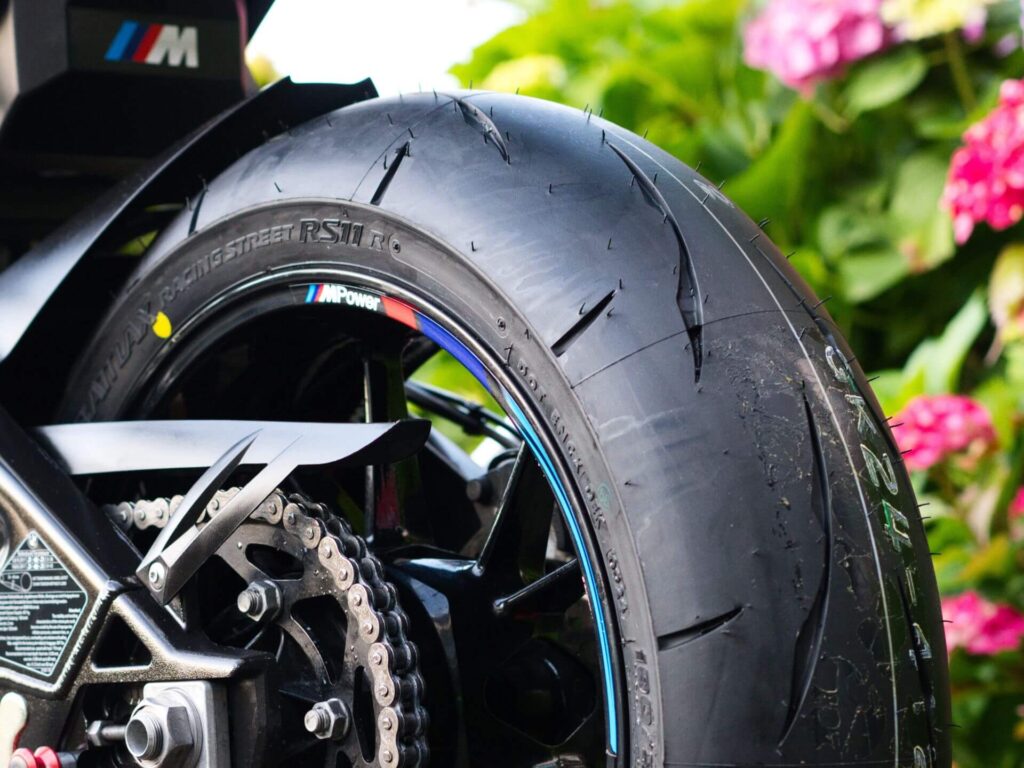
    Bridgestone Battlax RS11 BMW S1000R Rear Wheel
    Brandnew Battlax RS-11 Semi-Slick Tyre with closed rubber surface.

    How to break in new motorcycle tires

    If you only ride in a straight line, you’ll only break in the center of the tire. That’s why it’s best to choose a twisty, familiar route. This allows you to break in the tire flanks and gradually increase your lean angles in a controlled environment. Always take it easy during the break-in period. Don’t push too hard, especially in corners, where lack of mechanical grip can quickly lead to a slide.

    Riders of modern bikes equipped with lean-sensitive traction control and cornering ABS have a slight advantage. These safety systems can boost confidence during break-in and help defuse risky situations. Still, you should never rely solely on electronics when breaking in motorcycle tires!
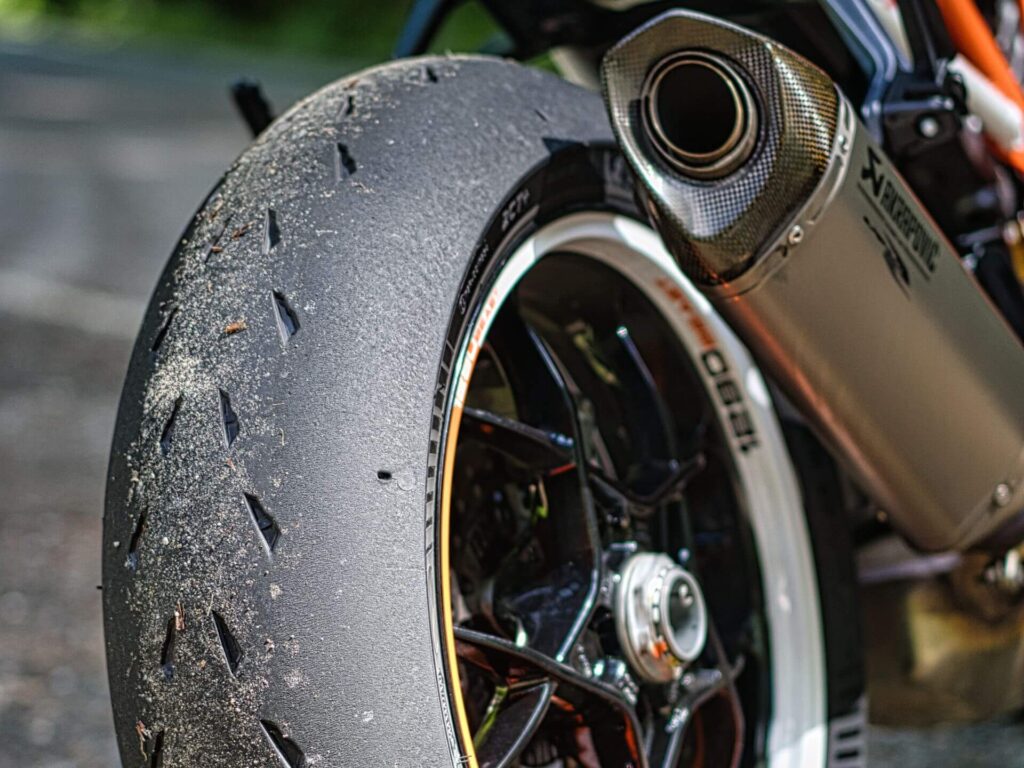
    Michelin Power Cup 2 on KTM 1290 Super Duke
    Well used Michelin Power Cup 2 with a lot mechanical grip!

    What about using sandpaper to break in tires?

    You’ll often read online or in forums that you can break in motorcycle tires by sanding them with sandpaper. It might sound logical and simple but it’s complete nonsense. The idea is to roughen up the smooth surface and supposedly remove the release agent. In theory, the tire is then “instantly broken in” and ready to grip.

    From a technical standpoint, this is total nonsense. This myth comes from the days when release agents left a slippery film on the tire. Today, every major high-tech tire manufacturer no longer uses those agents. There’s no longer any risk of slipping due to chemicals on the rubber.

    What really matters is the porosity of the tire surface. Imagine the tire and asphalt as tiny interlocking gears. A new tire has a sealed rubber structure, which reduces grip. Only through riding, and the heat it generates, does the rubber open up and “mesh” with the asphalt’s pores. A new tire doesn’t offer full grip yet, but that doesn’t mean it has none at all!

    You should never sand your tires. In the worst case, you could damage them. Sanding offers no benefit, because it doesn’t create the natural surface opening needed for proper grip. We strongly advise against sanding motorcycle tires. And to be clear: there is NO tire manufacturer that recommends sanding tires after mounting to improve or speed up the break-in process.

    Your opinion matters! How seriously do you take the break-in process for motorcycle tires? Have you had any bad experiences with new tires? Feel free to leave us a comment—we’d love to hear your thoughts!

    Visited 32 times, 1 visit(s) today
    Follow on Facebook Follow on Instagram Follow on TikTok
    Share. Facebook Twitter Email WhatsApp Telegram Copy Link
    Previous ArticleMotorcycle Tire Repair Spray Recommendations
    Next Article Motorcycle Tire Age – How Old Is Too Old?
    Biketyres24
    Biketyres24-Team
    • Website

    At Biketyres24.com, we live and breathe motorcycle tyres. As a global tyre dealer, we ship trusted brands worldwide and provide riders with expert reviews, hands‑on guides, and practical tips to keep every journey safe and smooth.

    Related Posts

    Why racing tyres are so expensive: material costs, manufacturing, and testing effort

    04.10.20261 Views

    How to Properly Warm Up Your Tires on Track Without Warmers

    13.09.20269 Views

    Pirelli Slicks Rim Compatibility Guide

    02.08.202619 Views
    Add A Comment
    Leave A Reply Cancel Reply

    Top Posts
    6.7

    Dunlop Sportsmart MK4 Review & Rider Experiences

    27.03.2026262 Views

    CFMoto 675 Tyre Recommendations: The Best Tyres for 675 NK & 675 SR‑R

    05.06.2026107 Views
    7.3

    Bridgestone Battlax RS12 Review & Rider Experiences

    31.05.2026107 Views
    Stay In Touch
    • Facebook
    • WhatsApp
    • Instagram
    Latest Reviews
    6.2
    Reviews
    4 Views

    Apollo Tramplr XR Review & Rider Experiences

    03.09.20265 Mins Read
    7.2
    Reviews
    21 Views

    Maxxis Supermaxx HS Review & Rider Experiences

    20.08.20265 Mins Read
    9.0
    Reviews
    23 Views

    Bridgestone Battlax RS12 Trackday Review

    29.07.2026Updated:02.08.20268 Mins Read
    Shop Biketyres24
    Most Popular
    6.7

    Dunlop Sportsmart MK4 Review & Rider Experiences

    27.03.2026262 Views

    CFMoto 675 Tyre Recommendations: The Best Tyres for 675 NK & 675 SR‑R

    05.06.2026107 Views
    7.3

    Bridgestone Battlax RS12 Review & Rider Experiences

    31.05.2026107 Views
    Our Picks

    Pirelli Slicks Rim Compatibility Guide

    02.08.2026

    CFMoto 675 Tyre Recommendations: The Best Tyres for 675 NK & 675 SR‑R

    05.06.2026

    How to Break In New Motorcycle Tires: Tips, Duration & Common Myths

    24.03.2026
    Reviews by Manufacturer
    Apollo Avon Bridgestone Continental CST Dunlop Heidenau Maxxis Metzeler Michelin Mitas Pirelli
    Biketyres24 Blog
    Instagram TikTok Facebook WhatsApp RSS
    • Home
    • Imprint
    • Privacy
    • Buy Now – Shipping Worldwide 🌍
    © 2026 Biketyres24.com Motorycyle Tyres Worldwide.

    Type above and press Enter to search. Press Esc to cancel.