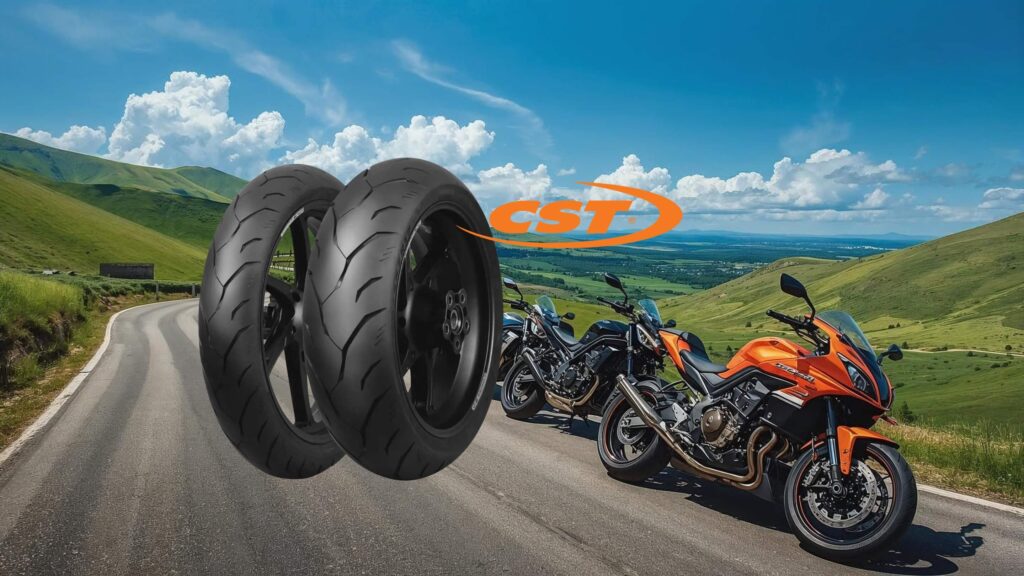
CST Ride Migra Score
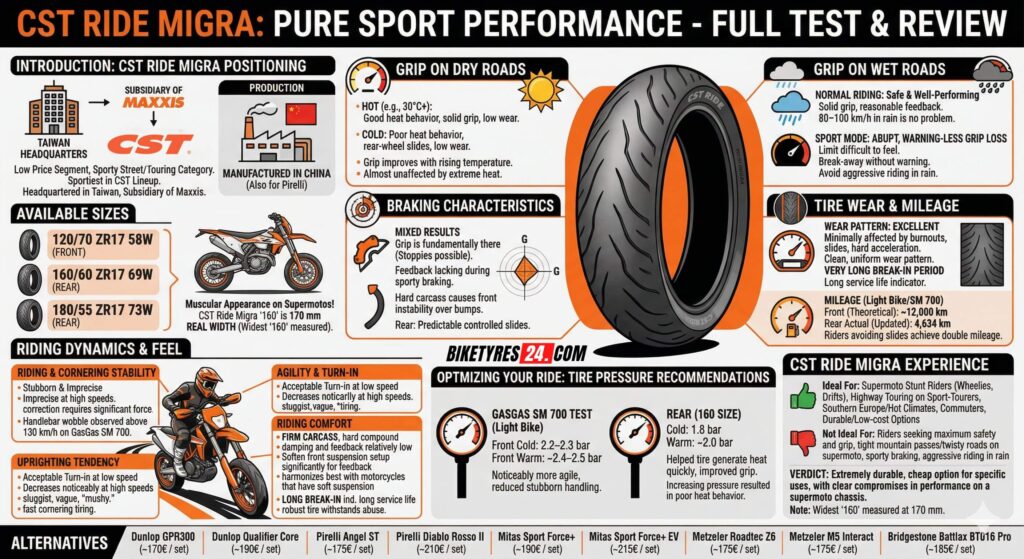
The CST Ride Migra is a budget-focused entry into the sporty street/touring segment. As a subsidiary of Maxxis, CST delivers a robust, extremely durable tire that prioritizes longevity and price over high-end performance feedback. It is a "workhorse" tire that excels in hot climates and high-abuse scenarios (like stunting or commuting) rather than precision corner carving.
The Good
- Durable
- Cheap
- Stable
The Bad
- Stubborn handling
- Almost no feedback
- Narrow grip limit zone
- Slow warm up
-
Grip Dry
-
Grip Wet
-
Warm-Up
-
Handling
-
Mileage
-
Value for Money
CST is a subsidiary of Maxxis and is headquartered in Taiwan. CST Tires primarily targets the lower price segment and therefore offers a wide portfolio of entry‑level street tires. The Ride Migra is currently the sportiest tire in CST’s lineup and sits in the sporty street/touring category. To achieve the low price point, CST tires are manufactured in China – which is not necessarily a disadvantage, as well‑known brands like Pirelli also operate production facilities in China.
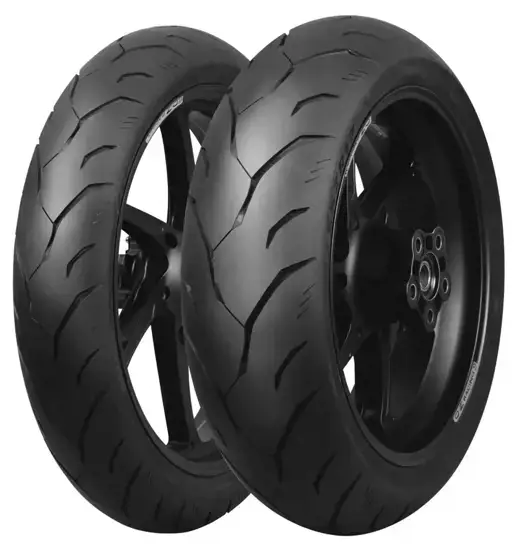
The CST Ride Migra is available in three sizes: 120, 160, and 180. This makes it particularly interesting for supermotos. We tested the CST Ride Migra extensively on the GasGas SM 700 and did not hold back in terms of sporty riding. How the affordable CST tire performs on the road is explained in detail in our CST Ride Migra review.
Table of Contents
CST Ride Migra Review
In our CST Ride Migra test, we subjected the tire to a realistic long‑term endurance test and rode it from new to the wear limit on our GasGas SM 700. We did not spare the tire in any way — we rode it just as hard as we ride other tires on our supermotos. We even took the Ride Migra to a supermoto racetrack to evaluate its performance under extreme conditions.
How the Ride Migra CM‑S1 performs in terms of grip, agility, comfort, and wear is detailed in the following sections.
Available Sizes
- 120/70 ZR17 58W
- 160/60 ZR17 69W
- 180/55 ZR17 73W
Grip on Dry Roads
Grip on the CST Ride Migra is a double‑edged sword. Due to its extremely hard compound, the tire only performs well in warm to hot temperatures. It generally struggles to build heat, especially in cooler weather. In midsummer at around 30°C, the Ride Migra reaches operating temperature more easily and performs noticeably better.
In cold conditions, rear‑wheel slides can occur, although we never had issues with the front during our long‑term test. The Ride Migra clearly prefers hot summer temperatures – grip improves significantly as temperatures rise. One advantage of this heat behavior is that the tire is almost unaffected by high temperatures. Even during aggressive supermoto riding at over 35°C, the tire does not break down and delivers sporty grip at an average sport‑touring level.
Summary of Dry Grip
- Hot temperatures → good heat behavior, solid grip, low wear
- Cold temperatures → poor heat behavior, low grip, low wear
Grip on Wet Roads
In the wet, the Ride Migra performs well during normal riding. It still offers solid grip and reasonable feedback. Riding at 80–100 km/h on country roads in the rain is no problem.
Issues arise only when switching into “sport mode.”
- Under hard braking, the ABS at the front tends to intervene more often than in the dry.
- At the rear, grip can break away abruptly.
- The limit is difficult to feel, and grip loss happens with almost no warning.
These characteristics only appear during extremely sporty or provocative riding. We intentionally pushed the tire to explore its limits. For commuting or relaxed touring, the wet performance is sufficient – but aggressive riding in the rain should be avoided.
Braking Characteristics
The braking performance of the Ride Migra did not fully convince us.
- Stoppies are possible, so grip is fundamentally there.
- However, during sporty braking, feedback is lacking.
- Riders who like to trail brake and feel what the front tire is doing at the limit will not be happy with the Ride Migra.
The hard carcass also causes bumps and uneven surfaces to negatively affect braking stability at the front. In cooler temperatures and during sporty riding, the ABS at the front intervened more often than expected. Adjusting suspension damping and rebound helped slightly, but not significantly.
The rear also offers less braking grip compared to other tires. In supermoto mode (rear ABS off), we could make the CST Ride Migra slide more easily than almost any other tire. For riders who value maximum safety and grip, this is not ideal – but on a supermoto, it can actually be fun and useful for practicing controlled slides.
For stunt riders or those who enjoy drifting, this characteristic is genuinely entertaining. Touring riders who want strong braking grip and high safety will likely be disappointed.
Riding Comfort
The Ride Migra has a very hard carcass and a hard compound. As a result, damping and road feedback are relatively low. On the GasGas SM 700, we had to soften the front suspension significantly to match the tire. Only with a softer setup could we achieve the damping that the tire itself does not provide, which also improved feedback.
Despite this, overall riding comfort is not bad. The Ride Migra can be ridden comfortably over longer distances. In our view, it harmonizes best with motorcycles that have a soft suspension setup.
Tire Wear
The wear pattern of the Ride Migra is excellent. Sliding, burnouts, and hard acceleration do not seem to affect the tire’s very hard compound. Even during long, sporty rides on rough country‑road asphalt, the Ride Migra shows only minimal wear and maintains a clean, uniform wear pattern. Subjectively, the CST Ride Migra’s handling even improves as mileage increases – likely because the relatively deep tread pattern gradually becomes shallower.
The Ride Migra also requires a long break‑in period. We have rarely ridden a tire that needed so many kilometers before reaching its full grip potential. This is certainly due to the hard compound, but it is not a negative point. On the contrary: a long break‑in period usually indicates long service life.
Overall, the Ride Migra is a very robust tire that withstands almost anything with minimal wear.
Mileage
The mileage of the CST Ride Migra can be described as excellent. Around 10,000 km on the front should be no problem — which is remarkable for a supermoto, as the SM 700 normally wears front tires much faster.
On the rear, our test bike could theoretically achieve around 4,000 km before reaching the wear limit. However, it must be noted that we did not spare the rear tire during testing: hard acceleration, wheelies, burnouts, and heavy rear‑brake use were part of the test routine. Riders who treat the tire more gently and avoid burnouts and slides should easily achieve double the mileage.
- Rear actual mileage: 4,634 km
- Front theoretical mileage: approx. 12,000 km
Riding Stability / Cornering Stability
At high speeds, the CST Ride Migra feels stubborn and imprecise. Once on a line, it holds it firmly, but changes require significant force and body input. In fast corners, the tire feels vague and unstable. On our GasGas SM 700, we also experienced handlebar wobble above 130 km/h – something we did not observe with other tires on the same bike.
We can imagine that the Ride Migra may perform better on heavier motorcycles, where the additional weight could stabilize the carcass and improve precision.
Agility / Turn‑in Behavior
The CST Ride Migra is not very agile.
- In tight corners and at low speeds, agility is acceptable and turn‑in is fine.
- At higher speeds, agility decreases noticeably.
- The tire becomes sluggish, not in a stable and precise way (like a ContiSportAttack 4), but in a vague, “mushy” way that requires a lot of rider input to compensate.
Fast cornering on country roads becomes tiring relatively quickly, as maintaining the line or making corrections requires significant effort – at least on a supermoto.
Uprighting Tendency
The Ride Migra shows almost no uprighting tendency. Even under hard braking at lean, our GasGas SM 700 did not stand up. This characteristic is excellent.
Tire Pressure
Finding the right tire pressure for the CST Ride Migra is tricky. We had to experiment extensively to improve its behavior on the supermoto.
Front Tire
- Cold: 2.2–2.3 bar
- Warm: approx. 2.4–2.5 bar
This is higher than GasGas’ recommendation, but it makes the front noticeably more agile and reduces the stubborn handling.
Rear Tire (160 size)
- Cold: 1.8 bar
- Warm: approx. 2.0 bar
This pressure helped the tire generate heat more quickly and improved grip.
Increasing the pressure significantly resulted in very poor heat behavior. Below 30°C ambient temperature, the tire barely warmed up – even with sporty riding – leading to abrupt, unpredictable slides when accelerating at lean.
Comparison: GasGas recommends 2.0 bar front and rear, but in our experience, the Ride Migra:
- feels too vague at the front with low pressure
- does not warm up sufficiently at the rear
CST Ride Migra Experiences
We suspect the Ride Migra was developed for the Southeast Asian market, where temperatures are consistently high. In such climates, the tire warms up properly and allows moderately sporty touring. The hard carcass and robust construction also suit Southeast Asian road conditions (poor surfaces, potholes, risk of tire damage).
Our long‑term experience shows that the Ride Migra is extremely durable. It easily withstands poor roads, wheelies, burnouts, and heavy abuse without significant wear. Riders who travel long distances on highways rather than twisty roads will be well served. For supermoto riders who enjoy wheelies and stunt practice, the tire is a cheap and durable option.
Recommended for:
- Highway touring on sport‑tourers and naked bikes
- Riders in Southern Europe or hot climates
- Commuters
- Riders seeking durable, low‑cost tire options
- Supermoto stunt riders (wheelies, drifts, spot riding)
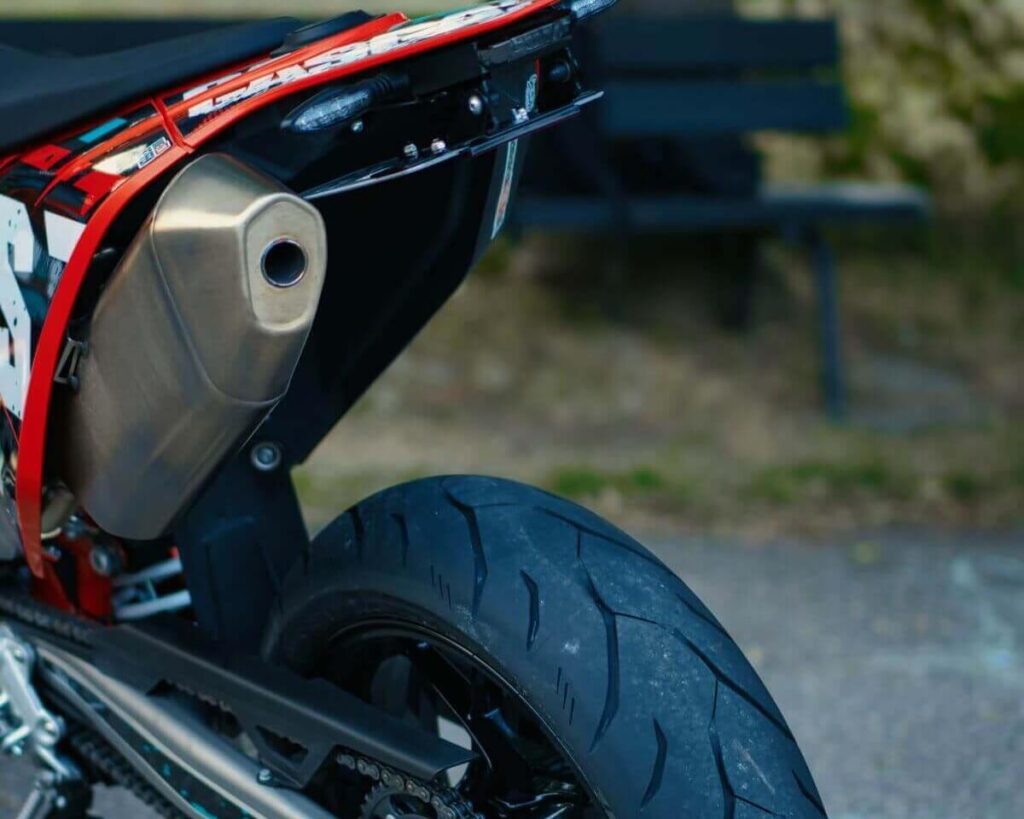
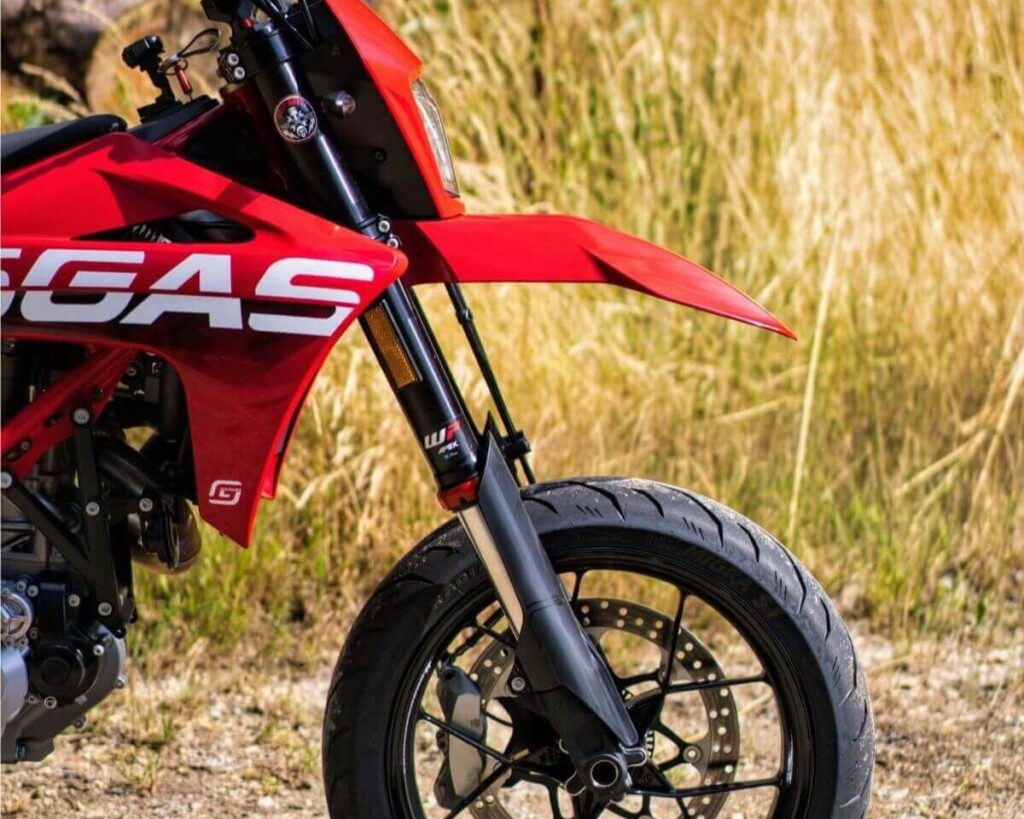
Note: The Ride Migra is extremely wide. On supermotos, it looks very muscular. With a real measured width of 170 mm, it is the widest “160” tire we have ever measured.
Alternatives to the CST Ride Migra
All alternatives below fall within the same price range (±30€ per supermoto set):
- Dunlop GPR300 (~170€ / set)
- Dunlop Qualifier Core (~190€ / set)
- Pirelli Angel ST (~175€ / set)
- Pirelli Diablo Rosso II (~210€ / set)
- Mitas Sport Force+ (~190€ / set)
- Mitas Sport Force+ EV (~215€ / set)
- Metzeler Roadtec Z6 (~175€ / set)
- Metzeler M5 Interact (~175€ / set)
- Bridgestone Battlax BT016 Pro (~185€ / set)