

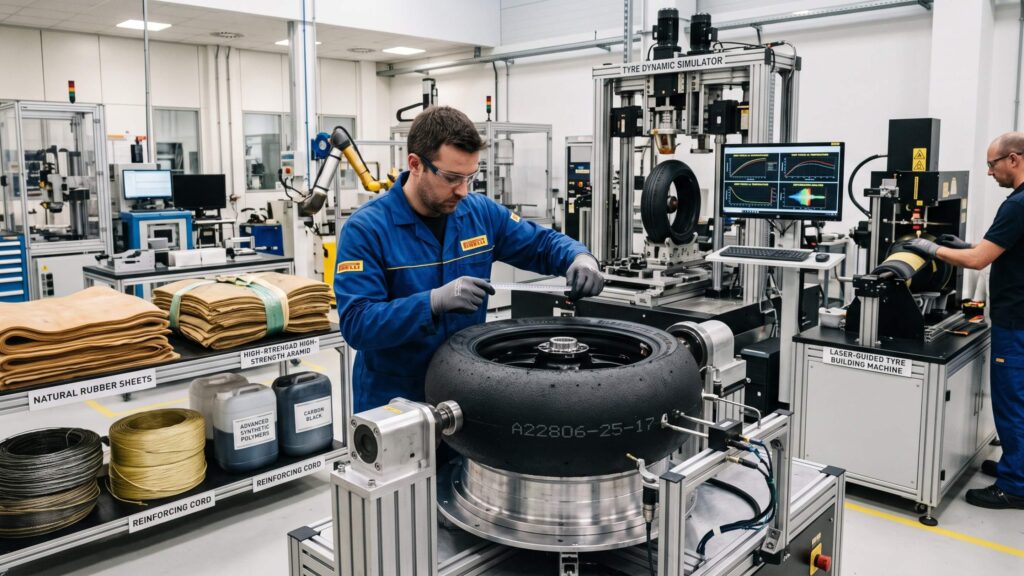
Racing tyres may look like “normal” motorcycle tires at first glance – just without tread. But every slick hides an enormous amount of engineering, development, and precision. Anyone who has ridden on a racetrack quickly realizes that these tires don’t just offer more grip; they fundamentally change the entire handling of a motorcycle. Steering response, stability, feedback, temperature window – everything follows its own rules.
This specialization is exactly what makes racing tires true high‑tech products, and their production is far more complex than that of regular street tires. In this article, you’ll get an inside look at why racing tires are so expensive and which cost factors play a role behind the scenes.
Table of Contents
🔧 1. Material Costs: High‑Performance Compounds Instead of Standard Rubber
Racing tires are not made from “normal” rubber. Manufacturers use expensive premium materials, special resins, and multi‑component compounds that deliver grip at extreme temperatures and high lean angles.
- The compound must work both cold and hot while providing maximum grip.
- Shoulders and center often use different compounds (multi‑compound).
- These materials are significantly more expensive than the long‑lasting compounds used in street tires.
→ Result: More grip, but also higher costs.
🏭 2. Manufacturing: Precision Instead of Mass Production
Motorcycle slicks are produced in small quantities – unlike mass‑market tires or car tires, which are manufactured millions of times.
- Every tire size requires its own molds, tools, and production lines.
- The carcass is wound with variable tension so the tire works perfectly both upright and at 55° lean angle.
- Overall, production is more complex because a motorcycle tire works in three dimensions – not just flat like a car tire.
→ Fewer units = higher production cost per tire.
🧪 3. Development & Testing: Labs, Tracks, Prototypes
Racing tires must withstand extreme conditions: full throttle, heavy braking zones, 200+ km/h, extreme lean angles, and repeated heat cycles. To reliably handle these loads, manufacturers invest millions in R&D, lab analysis, track testing, and prototypes. Every compound is tested on multiple racetracks, often with professional test riders who provide precise feedback on grip, stability, and temperature behavior.
International racing series like WSBK and MotoGP also serve as technological testbeds for tire development. New carcasses, compounds, and belt constructions are tested under real extreme conditions. Participation in these series is expensive: manufacturers must support teams on‑site, supply hundreds of tire sets per weekend, analyze data in real time, and manage logistics for global race calendars. Licensing fees and the requirement to develop track‑specific tire variants further increase costs.
- Manufacturers invest millions in R&D, lab work, track testing, and prototypes.
- Every compound is tested on multiple racetracks, often with pro riders or in actual race conditions.
→ Development effort is one of the biggest cost drivers for motorcycle slicks.
🏆 Conclusion: Racing Tires Are High‑Tech – and Priced Accordingly
Racing tires are not “better street tires” – they are precisely engineered high‑performance products designed to function under extreme conditions. They are expensive because:
- the materials are premium,
- the manufacturing is complex,
- the production volumes are small,
- the development costs millions,
- and the performance requirements are extremely high.
The longer and more successfully a racing tire model stays on the market, the cheaper it can eventually be offered – or in later generations – because only small optimizations are needed instead of complete redevelopment. At the same time, slicks like the Metzeler Racetec TD Slick are intentionally priced lower because they are designed specifically for trackday riders, focusing on solid performance, easy handling, and manageable costs.
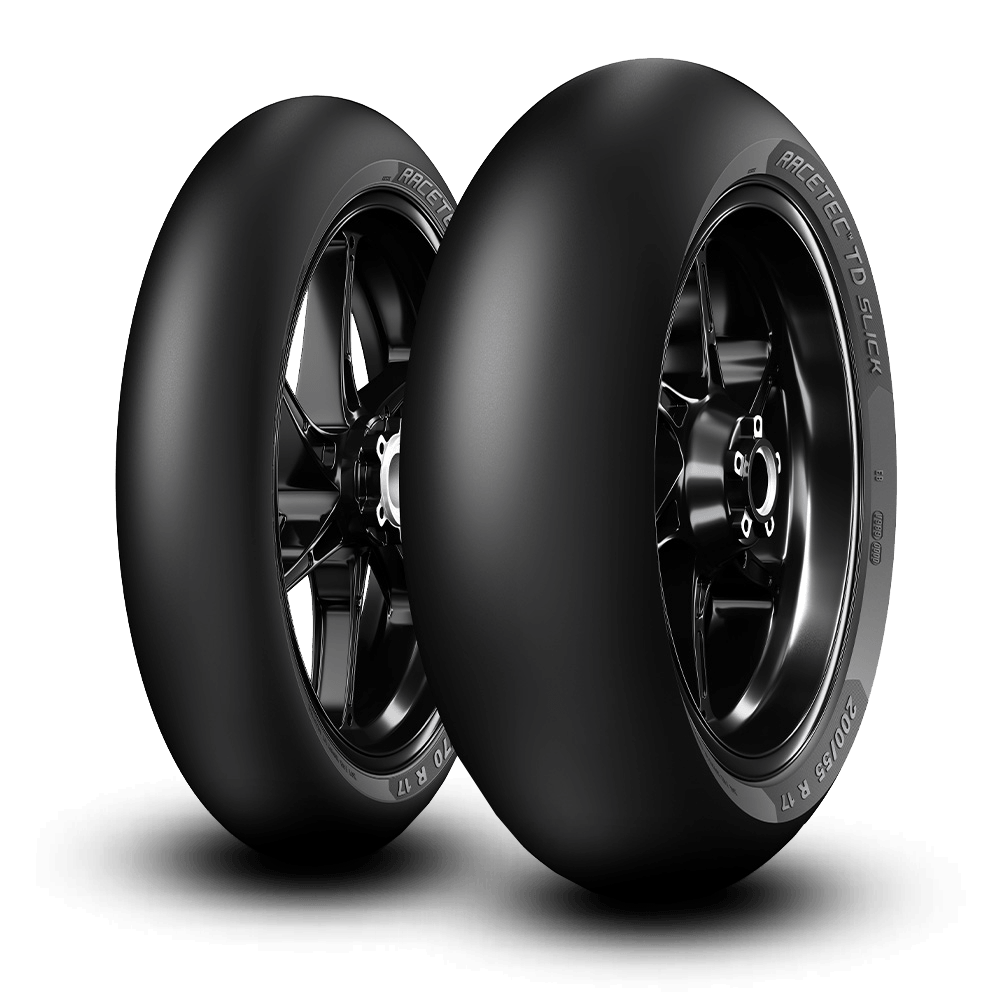
The TD Slick is the best example of lower cost combined with good performance.
Affordable alternatives from Asia, such as Kingtyre, can work up to a certain performance level, but they lack the same technical expertise, development resources, and extensive testing of the major premium manufacturers. This ultimately results in noticeable performance compromises, smaller safety margins, and a narrower temperature and load window.
Do you have any questions about the topic? Feel free to leave a comment!
Cover image generated with the help of AI.
