

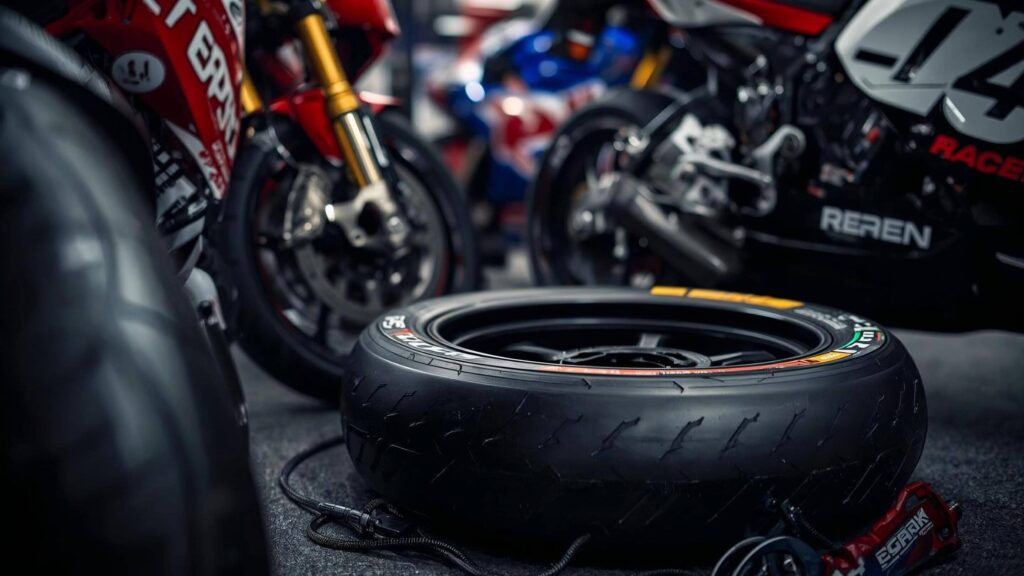
Motorcycle Slicks are expensive, highly engineered, and very sensitive. Even as a hobby racer or trackday beginner, you should familiarize yourself with the basics of racing slicks for motorcycles. From storage to mounting and identifying tire problems, we’ve summarized all the key points about slick tire handling in the sections below.
Table of Contents
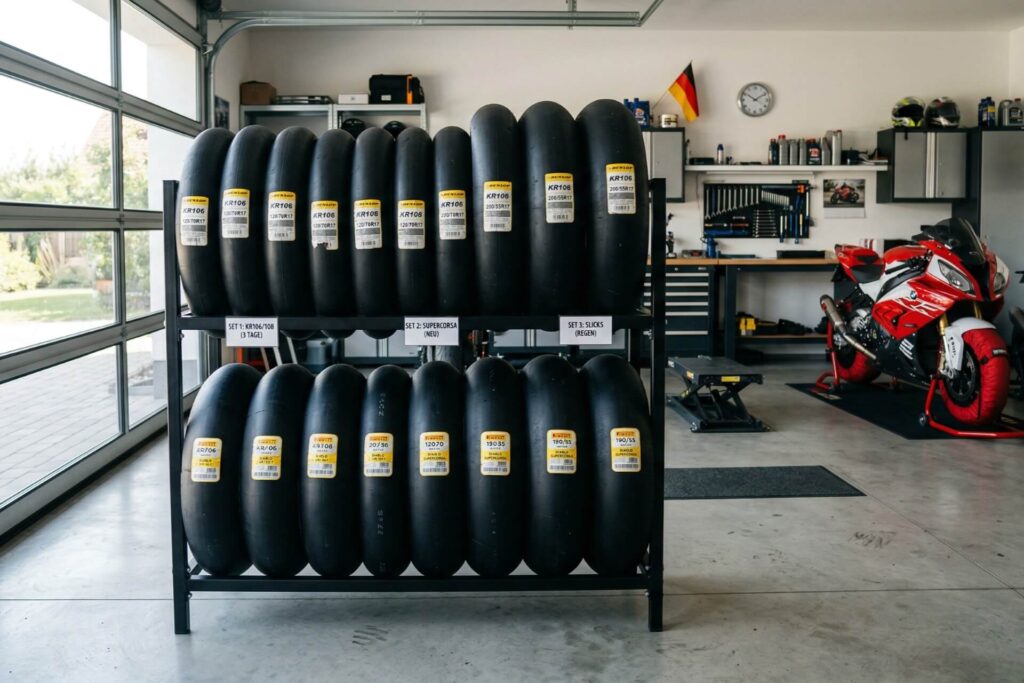
Storage of Motorcycle Slicks
Racing tires typically operate at tread temperatures starting around 80 °C. At lower temperatures, they are at risk of damage, especially on the tread surface—known as “glass break,” which appears as fine, barely visible cuts.
To avoid glass break:
- Store tires at a minimum of 5 °C, preferably higher (above 10-15 °C).
- Always store tires upright and individually, do not stack them.
- Do not drop, throw, or deform tires.
- Before mounting, store at 20 °C for at least 24 hours or preheat with a tire warmer for 1 hour.
⚠️ Handling slicks below 5 °C can cause cold fractures, making the tire unusable. Such tires must never be used again. For safety, avoid transporting, mounting, or operating racing tires below 5 °C.
Other factors that can damage slicks include:
- Tire age
- Improper storage conditions
- Wear and damage (punctures, cuts, impacts, cracks, blisters, deformations)
Mounting Slicks
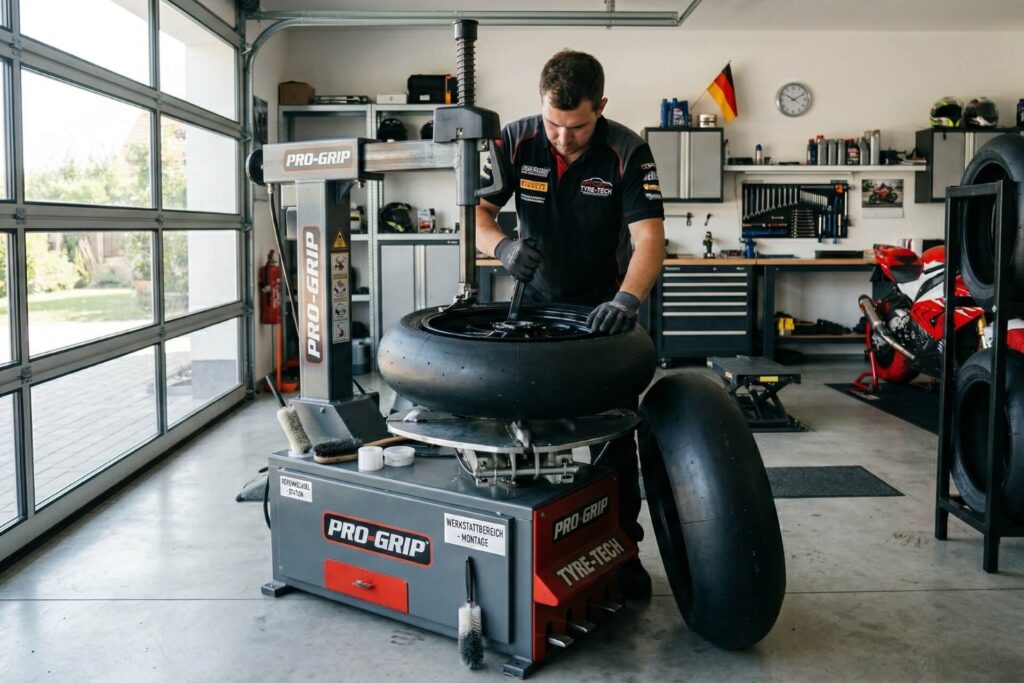
Slicks are mounted like standard motorcycle tires but:
- Never mount on damaged rims.
- Avoid rough handling (throwing, dropping).
- Ideally handle only at warm ambient temperatures.
- In winter, let tires acclimate in the workshop before mounting.
Using Tire Warmers
Tire warmers are required for nearly all slicks, with very few exceptions (e.g., Metzeler Racetec TD Slick).
Correct use of tire warmers:
- Switch on at least 1 hour before the first session.
- Keep tires heated throughout the day while parked.
- Avoid cooling cycles, as they reduce tire lifespan.
- After the last session, put warmers on warm tires and let them cool slowly (without power).
- Always check for stones or debris between tire and warmer before use.
Continuous heating and slow cooling extend slick lifespan and may allow reuse. Every cooling cycle harms performance and should be avoided.
Adjusting Tire Pressure for Slicks
Tire pressure is critical for performance and durability. Here are some issues which could arise with wrong tire pressure.
- Too little front pressure → less stability, flatter contour, poor handling.
- Too much rear pressure → smaller contact patch, reduced grip, harsher ride, higher wear.
Procedure:
- Switch on tire warmers at least 1 hour before riding.
- Check and set pressure to recommended values.
- After each session, return to the pits, check, and adjust pressure.
- Recheck several times a day, as track and air temperatures affect pressure.
Slick Tires on Dyno
For dyno runs, always use separate, already-used tires. Heat buildup during testing can cause visible and hidden damage. Tires used on dynos must not be ridden afterward.
Common Slick Tire Problems
- Weaving (high-speed wobble): Snake-like movement above ~140 km/h, caused by cuts, punctures, or tread damage.
- Kick-back: Sudden violent handlebar movement during acceleration, triggered by road irregularities.
- Shimmy: Fast front-wheel oscillation at constant speed (60–100 km/h).
- Vibrations: Caused by unbalanced wheels, noticeable between 90–130 km/h.
Influence factors:
- Wear level, tire pressure, tire construction, rim centering, and balancing all strongly affect stability and handling.
Do you have further questions about slick tire handling? Leave us a comment below – our experts will be happy to help!
